

Collect, store, and visualize your metrics - all in one place
All about nmaas
Metrics
nmaas Metrics is a flexible platform for collecting, consolidating, and visualizing data from multiple systems within a unified dashboard, enabling organizations to monitor project progress, track service KPIs and SLA compliance, analyze infrastructure performance, and measure user engagement in real time. By integrating data from source code repositories, CI/CD pipelines, monitoring systems, APIs, and other external services, it transforms distributed operational data into clear, actionable insights. With extensible workflows, multi-tenant dashboards, and optional AI-enhanced reporting, nmaas Metrics supports data-driven decision-making across technical, operational, and management domains.
Everything
you need

Easy Data Acquisition
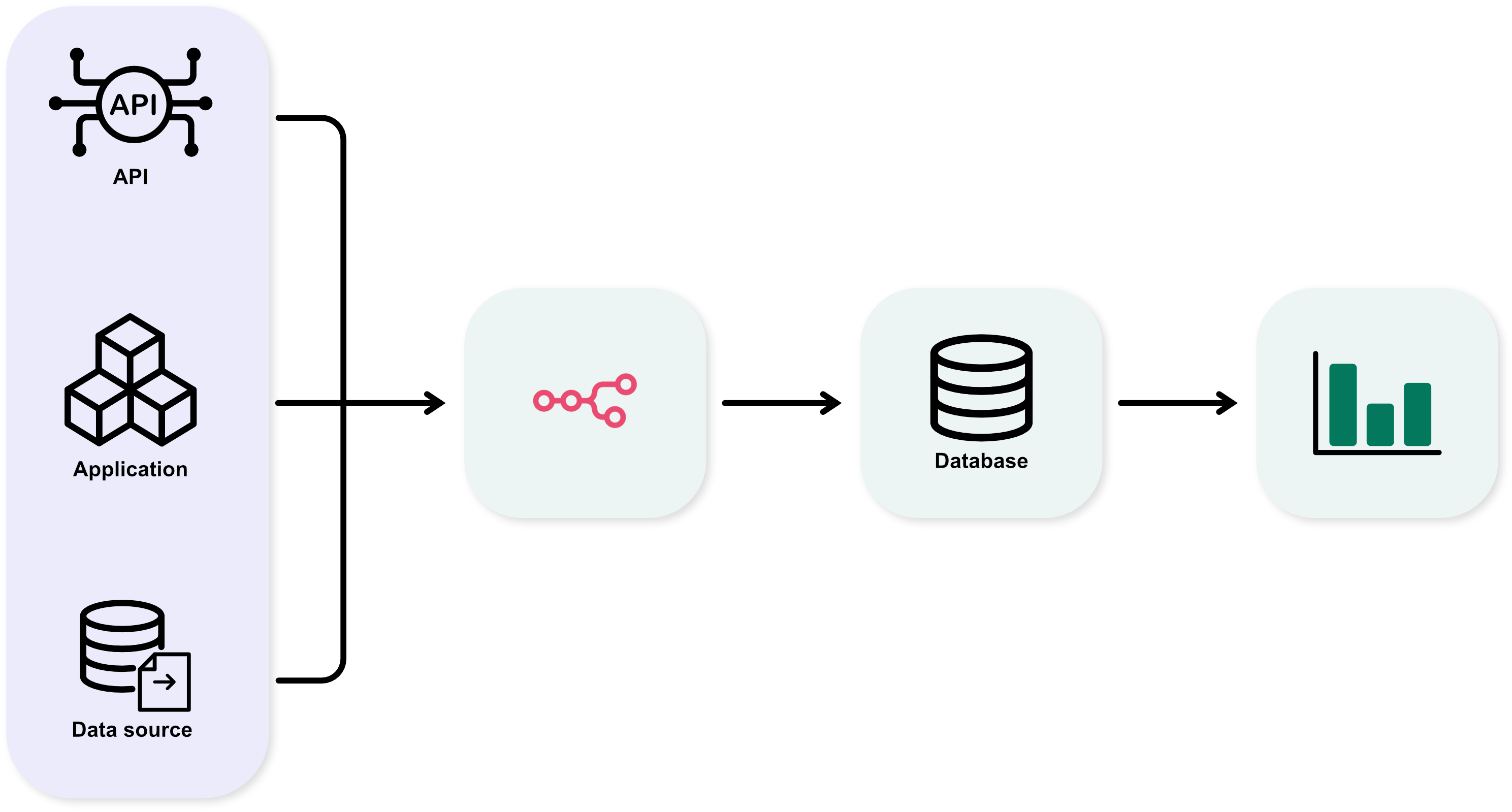
Meaningful insights start with reliable data. nmaas Metrics offers ready-made integrations for more than 100 systems through supported open-source applications. Need something custom? Additional integrations can be quickly created using the N8n workflow automation tool available in the nmaas catalog, giving you full flexibility to connect virtually any data source.
Flexible Data Storage
Choose where your metrics live. Store data in applications running on nmaas or in your preferred third-party cloud platform. PostgreSQL is available directly in the nmaas catalog, providing powerful support for both structured and unstructured data thanks to its JSONB capabilities. With broad driver compatibility, your data remains easily accessible for analytics and visualization tools.

Powerful Visualizations
Understanding your data requires clear and intuitive dashboards. nmaas Metrics integrates with Metabase and Grafana to deliver rich visualizations tailored to different needs. Use Metabase to explore business metrics and track KPIs, and Grafana to monitor system performance and technical metrics. Both platforms support multi-tenancy with role-based access control, ensuring secure and organized dashboard management.

Broad Data Source Compatibility
Data exists in many formats and systems. With Trino available in the nmaas catalog, you can query otherwise unsupported data sources and unify them under a single analytics layer. Through its JDBC interface, Trino enables seamless integration with systems such as Prometheus, Kafka, Elasticsearch, and Loki, giving you maximum flexibility in how and where your data is stored.

Extensible Application Catalog
The nmaas catalog is fully extensible, allowing new applications to be added at any time as platform requirements evolve. Analytics tools, monitoring components, workflow engines, and supporting data services can be incorporated to expand available capabilities over time. In this way, long-term adaptability is maintained while new functionality is introduced without reliance on fixed solutions.

Optional AI-Powered Workflows
Enhance your data workflows with intelligent automation. Thanks to N8n’s support for large language models (LLMs), you can incorporate AI into data cleaning, validation, enrichment, and even automated report generation. From acquisition to long-term storage, visualization, and AI-assisted reporting, nmaas Metrics supports the complete data lifecycle within a single, flexible ecosystem.
A sneak peek at nmaas
Metrics
...
Automated Data Collection with N8n
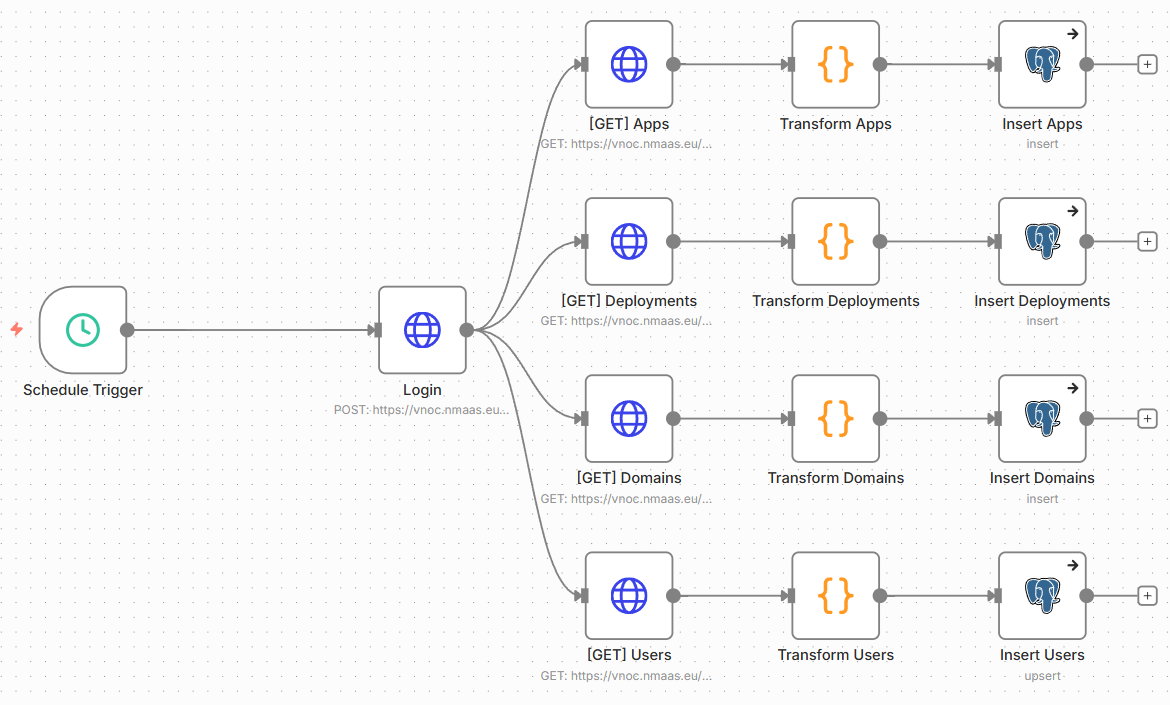
N8n brings powerful workflow automation to nmaas Metrics, enabling teams to seamlessly collect data from virtually any external source, whether that's REST APIs, web scraping, cloud services, or third-party platforms. Through its intuitive visual workflow editor, users can chain together data collection, transformation, and enrichment steps, cleaning and reshaping raw data into structured formats before automatically persisting it into a relational database. This end-to-end pipeline, from source to storage, runs on a schedule or in response to triggers, ensuring your KPI and goal data is always fresh and ready for instant visualization, turning what was once a complex engineering effort into a simple, maintainable workflow anyone on your team can own.
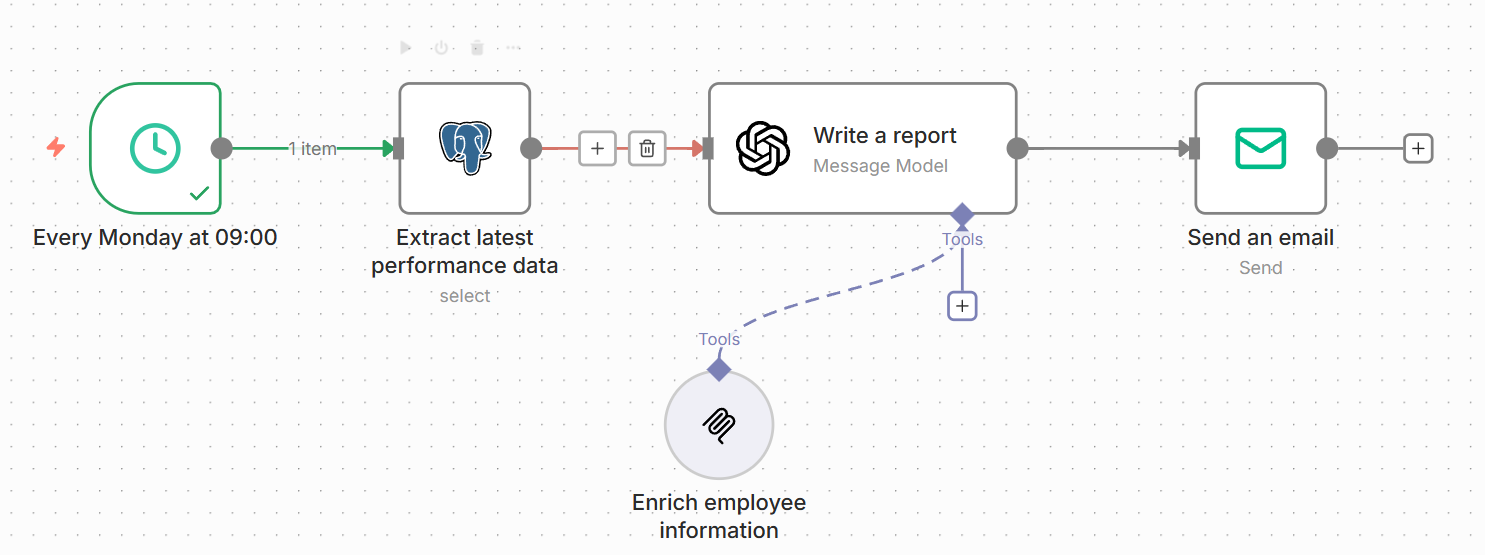
AI-Assisted Processing
N8n's native AI integration takes data workflows beyond simple automation, allowing teams to embed intelligent processing directly into their pipelines. Using n8n's built-in AI nodes, users can connect to large language models to automatically classify, summarize, or extract structured insights from unstructured data sources — turning raw text, documents, or API responses into clean, meaningful metrics ready for analysis. This means that even data sources without a well-defined structure, such as news feeds, social media, or free-form reports, can be reliably processed and normalized before being stored in the database. Workflows can also be used to generate automatic summaries of newly collected data, prepare recurring reports, and trigger notifications when important changes or threshold breaches are detected. By weaving AI into the collection, transformation, and reporting layer, nmaas Metrics empowers teams to monitor KPIs that would otherwise require significant manual effort to track, helping ensure that targets are continuously assessed.
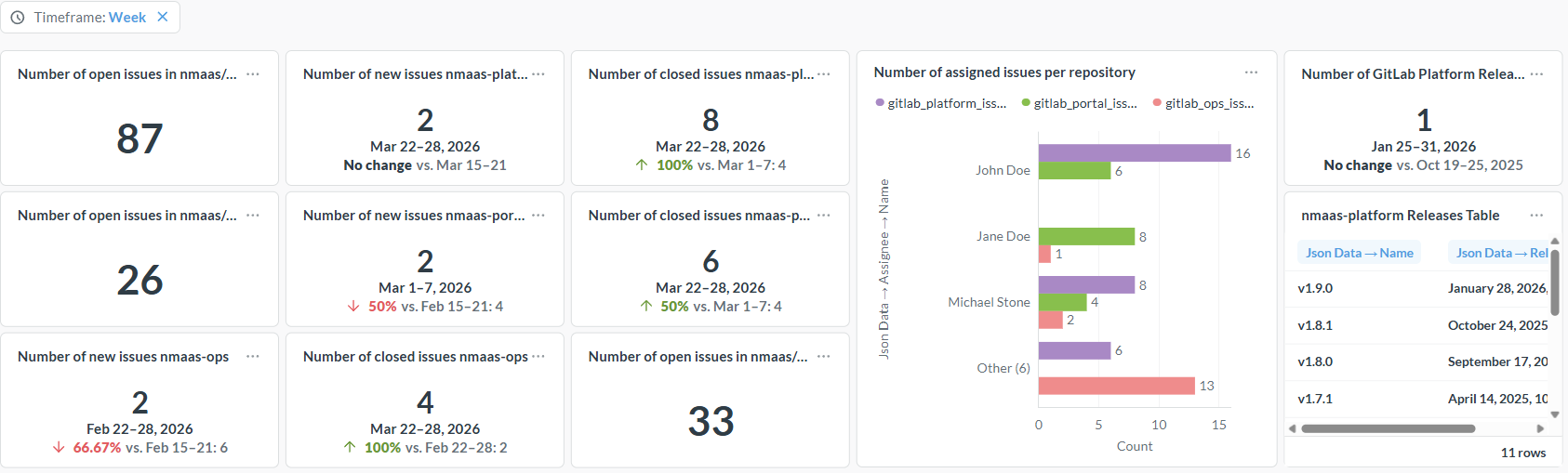
Interactive Dashboards with Metabase
Once data has been collected and stored through N8n workflows, Metabase provides a clear and accessible way to explore, analyze, and present it. Dashboards can be created to track KPIs, service usage, project activity, or operational trends, with charts and tables built directly on top of the underlying database. This makes it possible to move from raw, continuously updated data to structured visual insights that support day-to-day monitoring as well as higher-level reporting, all within an interface that can be easily adapted to different audiences and use cases.
Universal Querying with Trino
Trino acts as a universal query engine within nmaas Metrics, making it possible to work with data sources that do not natively expose a traditional SQL interface. By presenting these sources through a SQL-compatible layer, Trino allows data from different systems to be queried and combined directly from analytics tools such as Metabase. A particularly valuable example is the integration with Prometheus, where infrastructure and application performance metrics such as CPU usage, memory consumption, request latency, and error rates can be brought together with business KPIs in the same dashboard. This creates a more complete view of both service health and operational progress within a single reporting environment.
Example
usage
Monitoring Key Performance Indicators
nmaas Metrics allows you to track all your key performance indicators within a single, unified dashboard. These capabilities are not only theoretical — they are actively used by the nmaas Team in day-to-day operations to support data-driven management and transparency. By integrating with external systems, you can:
- Monitor development activity in source code management platforms such as GitLab, gaining visibility into contributions, workload distribution, and potential bottlenecks.
- Track application deployments and user registrations by consuming data from the nmaas Platform API, helping you understand adoption trends and service growth.
- Oversee content publishing schedules through RSS integrations, ensuring regular communication and timely updates.
Log presentations, outreach activities, or other organizational events via custom data ingestion endpoints, keeping a clear record of dissemination efforts. By bringing together data from multiple sources into a cohesive analytics layer, nmaas Metrics transforms scattered operational information into structured insights that support informed decision-making and continuous improvement.
AI-Enhanced Data Workflows
Beyond traditional metrics collection and visualization, nmaas Metrics can power intelligent, AI-enhanced workflows that automate analysis and reporting tasks. By combining N8n automation with large language model (LLM) capabilities, organizations can move from simple data aggregation to smart data processing.
Typical examples of supported automation include:
- Incoming data streams from monitoring systems, ticketing platforms, or APIs can be automatically validated, cleaned, and enriched before being stored.
- AI models can classify incidents, summarize large log datasets, detect anomalies in KPI trends, or generate executive-ready performance summaries on a scheduled basis.
This approach enables teams to reduce manual reporting effort, improve data quality, and gain faster insights from complex datasets. Instead of simply visualizing what happened, AI-enhanced workflows help explain why it happened and automatically prepare clear, actionable summaries for technical teams and management alike.
How to get
started
?
Explore nmaas Metrics in your environment
To get started with nmaas Metrics, a deployment can be prepared on existing infrastructure and adapted to specific data collection, storage, and visualization requirements. This makes it possible to begin integrating operational data sources, building dashboards, and evaluating reporting workflows according to organizational needs.
Learn moreContact us through nmaas mailing lists

nmaas@lists.geant.org: If you want to reach the core nmaas team and discuss usage options, deployment scenarios, or for any general inquiry

nmaas-users@lists.geant.org: Discussions related to nmaas usage and development (subscribe here)

nmaas-announce@lists.geant.org: Announcements shared by the nmaas team with the community (subscribe here)
Explore
other
use cases
nmaas Virtual Lab is a cloud-based solution facilitating organization of hands-on exercises in the context of both formal, supervised, education (e.g., university courses), as well as for informal, and self-paced education (MOOCs, short demos, tutorials). nmaas Platform provides all the required functionalities and suitable portfolio of integrated applications to allow setting up online laboratories as effortless as possible from the educators and learners perspective.
nmaas Virtual NOC is a cloud-based, multi-tenant network management platform that simplifies network and service monitoring for organizations. It offers a suite of network management tools through a secure web portal and supports both managed and self-hosted instances. nmaas Virtual NOC helps organizations efficiently manage and monitor their networks without the need for setting up and maintaining in-house infrastructure.
nmaas ActiveMon enables organisations to deploy and manage active network monitoring tools on remote Kubernetes clusters directly from the nmaas portal. Technologies such as perfSONAR and Smokeping support distributed measurements of throughput, latency, packet loss, jitter, round-trip time and path characteristics close to the monitored infrastructure. nmaas simplifies deployment and lifecycle management across multiple locations, while central dashboards provide a unified view of results, helping operators detect performance issues and maintain visibility across distributed networks.